Why Can I Smell Gas When My Appliances Are Turned Off?
If you notice a gas smell in your house while every appliance appears to be off, do not assume the smell is harmless. An appliance control being off does not mean its connected pipework is no longer carrying gas. A leak can occur in supply pipes, connections or appliance components even when nothing is operating. Plumbing Inspectors can help Brisbane homeowners understand when they need licensed gas-fitting assistance, but safety must always come first.
Knowing what to do next matters more than identifying the faulty part. An unexplained gas smell needs prompt attention, even if it comes and goes or seems to be strongest near an appliance. The following information explains why a leak is possible when appliances are switched off, how to respond safely and what needs to happen before normal gas use can resume.
What Should I Do If I Notice a Gas Smell?
Treat an unexplained gas smell as a potential leak, even if the stove, heater or hot water appliance is not operating. The priority is to move everyone away from the affected area and contact emergency assistance rather than investigate the source.
Avoid flames, smoking, electrical switches and appliance operation. Do not turn anything on or off to check whether it is working. If there is a fire, explosion, uncontrolled leak or immediate danger, evacuate and call 000 from a safe location. The Queensland Fire Department also identifies smelling gas as a reason to contact Triple Zero.
Leave the Affected Area and Keep Others Away
Move away promptly and encourage anyone nearby to leave with you. Do not delay to collect belongings, inspect an appliance cupboard or look behind a cooker. Avoid using lifts if leaving a building and do not re-enter to investigate.
Once outside, move well away from the property or suspected leak. Do not use a phone, operate electrical equipment or create an ignition source near the affected area. Keep other people away while waiting for assistance.

If the property is part of a unit complex or shared building, let emergency responders know that other households or common areas could be affected. There is no need to establish which property the smell originated from before reporting the concern.
Do not attempt to locate a valve, disconnect an appliance or carry out a leak test. Safety guidance includes ventilating an affected area and isolating the gas supply where appropriate, but these actions should never delay evacuation or require anyone to approach a suspected leak. Follow emergency instructions and only undertake an action if it can be done safely.
Contact Emergency Assistance From a Safe Location
Use a phone only after moving well away from the affected property. Call the emergency hotline and provide the property address, where the smell was noticed and whether anyone may still be inside.
There is no need for technical language. Explaining that a gas smell was noticed while all appliances appeared to be switched off is useful information. Mention any hissing sounds or previous occurrences if already known, but do not return to investigate.
For gas supply faults and suspected leaks, the distributor may also need to be contacted. The distributor's emergency contact details are listed on the gas bill under emergency or leaking gas contacts. The appropriate network depends on the property's location.
If the situation involves an uncontrolled leak, fire or another immediate threat, emergency services take priority over a routine supplier or repair enquiry.
The information on recognising a plumbing emergency provides broader context about urgent household plumbing problems. However, reading further should never delay evacuation or an emergency call.
Switched-Off Appliances Can Still Have a Gas Supply
An appliance can stop burning gas without the connected supply pipe becoming gas-free. That distinction explains why an unexplained smell needs attention even when no cooking, heating or hot water activity has taken place recently.
The position of an appliance control only indicates its apparent operating state. It does not establish the condition of every pipe, joint or component supplying it.
The Difference Between an Appliance Control and the Supply Pipe
A residential gas installation is a connected system rather than a collection of appliances that only receive gas while operating. Depending on the installation, supply pipework can remain under pressure while an appliance is idle. A fault in that pipework does not depend on a burner being lit.
Likewise, switching an appliance off electrically does not demonstrate that its gas connections are sound. Electrical power and gas supply have different functions. An inactive display, switched-off fan or unlit burner cannot confirm that the gas installation is safe.
Appliance designs and operating arrangements also vary. Some components may continue to have a gas supply even when the appliance is not actively being used. Homeowners do not need to understand these arrangements to make a safe decision. An unexplained gas smell warrants professional attention regardless of what the controls appear to show.
This is why checking that every knob is off is not a sufficient response to a continuing smell. It describes the appliances' apparent operating state but does not rule out a fault elsewhere in the installation.
Connections and Components That Need Professional Assessment
Potential faults can involve supply pipework, joints, appliance connections, valves or components within an appliance. The precise possibilities depend on the equipment and how the property receives gas.
A licensed gas fitter needs to assess the actual installation rather than assume the nearest appliance is responsible. Gas work includes installing, altering, repairing, servicing, testing and certifying gas systems, pipework and connections. Queensland regulations require this work to be carried out by licensed professionals.
Visible condition alone cannot establish whether a connection is safe. A pipe or fitting may look ordinary from the outside without its integrity having been tested. Similarly, the age or appearance of an appliance does not identify the source of an odour.
A recent service, newly installed appliance or long period without problems also does not prove that the entire installation is currently free of faults. These details are useful background for the attending professional, who can determine which parts need inspection and testing.
When arranging assistance from a safe location, mention any recent installation or repair work if already known. There is no need to retrieve paperwork from the affected area.
Can I Tell Where the Smell Is Coming From?
A gas leak cannot be reliably located by following the smell. Where an odour is noticeable may be different from where gas is escaping, so a smell near one appliance does not establish that appliance as the source.
Observations can help the responding professional, but they should come from what was noticed before leaving. Walking through the property to compare rooms or repeatedly entering to see whether the smell has changed is not a safe approach.
Air Movement Can Make the Source Difficult to Locate
Air moving through a property can carry an odour along hallways, through openings or between connected spaces. Ventilation, weather conditions and building layout can all influence where the smell becomes noticeable.
The properties of natural gas and LPG affect how a release behaves. Natural gas is lighter than air, while LPG is heavier and can collect in low areas. This means there is no single assumption about where gas will accumulate that applies to every residential installation.
This is important in homes with several gas appliances. The appliance closest to the strongest smell is not automatically the faulty one. Looking behind it, opening access panels or moving equipment could expose occupants to risk without establishing the cause.
When speaking to emergency responders or a licensed gas fitter, distinguish between an observation and an assumption. Saying the smell was noticeable in the kitchen is more useful than confidently naming the cooker as the source without evidence.
A Smell That Fades Is Not Proof the Area Is Safe
A smell can become less noticeable because conditions have changed, not because the underlying fault has been resolved. Air movement may disperse an odour temporarily, while continued exposure can also affect a person's ability to recognise it.
An intermittent smell still deserves attention. Waiting inside for it to return or restarting an appliance to reproduce the circumstances is not a safe diagnostic method.
If the smell disappears while everyone is waiting outside, report that change to the responding service. Let the professionals decide whether it affects their assessment. Assistance should not be cancelled solely because the odour is no longer noticeable.
Different people may also have different perceptions of the smell. One person noticing an odour while another cannot does not establish that the installation is safe. The original concern should still be reported accurately and assessed appropriately.
Emergency Assistance and Gas Fitting Have Different Roles
A suspected gas leak can require more than a repair appointment. Immediate danger, faults involving the gas distribution network and problems within the property's own installation may involve different types of assistance.
Understanding these responsibilities helps avoid delays and makes it easier to arrange the correct service. Emergency response and repair work are related, but they are not necessarily performed by the same organisation.
Immediate Danger Takes Priority Over Booking a Repair
Evacuate and call 000 if there is a fire, explosion, uncontrolled gas leak or immediate risk to people or property. Queensland Fire Department guidance also identifies the smell of gas as a reason to call Triple Zero.
Gas supply emergencies may also require assistance from the relevant distributor. The distributor is responsible for the gas network and associated infrastructure, including the street mains and the network connection to the metre.
Brisbane properties are not all supplied by the same distributor. Australian Gas Networks services the Brisbane CBD and northern suburbs, while Allgas Energy services the southern suburbs. The emergency contact listed on the gas bill is a useful starting point for identifying the appropriate network.
A distributor's emergency response team can assess certain supply-side problems and make the situation safe. However, this does not necessarily include repairing internal household pipework or faulty appliances.
If the property is rented or part of a managed building, notify the property manager or nominated contact once immediate safety concerns have been addressed. This helps coordinate access and repairs, but it should never delay an emergency call.
A Licensed Gas Fitter Assesses Faults Within Their Scope
Gas fitting requires qualifications and a licence. A business offering general plumbing assistance should not automatically be assumed to cover every gas appliance, supply arrangement or specialist repair. Before arranging gas work, check a gas fitter’s licence and permitted work to confirm that their licence is current and covers the assessment or repairs required.
If comparing emergency plumbers in Brisbane, ask specifically about licensed assistance. When contacting experts, explain the suspected gas issue and confirm whether the required assessment falls within the available service scope.
Useful questions include:
- Is a licensed gas fitter available to assess the reported issue?
- Can the attending professional work on the particular type of gas installation?
- Can they inspect the relevant pipework, connections and appliances?
- Will additional specialist or distributor assistance be needed if the fault is outside their scope?
An enquiry or repair booking is not permission to remain in an affected area. The property should only be re-entered when the emergency personnel or professionals advise that it is safe.
For future planning, preparing for household plumbing emergencies can help homeowners organise important contact details before a problem occurs. Keep emergency numbers somewhere accessible without needing to approach gas equipment during an incident.
What Happens Before I Can Use the Appliances Again?
Returning to normal use should follow professional assessment, any necessary repairs and confirmation that the affected equipment or installation can be used safely.
A smell disappearing or an appliance appearing to work is not enough. Where the supply has been isolated or equipment has been disconnected, it must not be restored or restarted until the qualified professional confirms that it is safe.
If different organisations have handled emergency response, supply work and repairs, you must understand which checks have been completed and whether any further approval is required.
Professional Testing to Establish the Fault
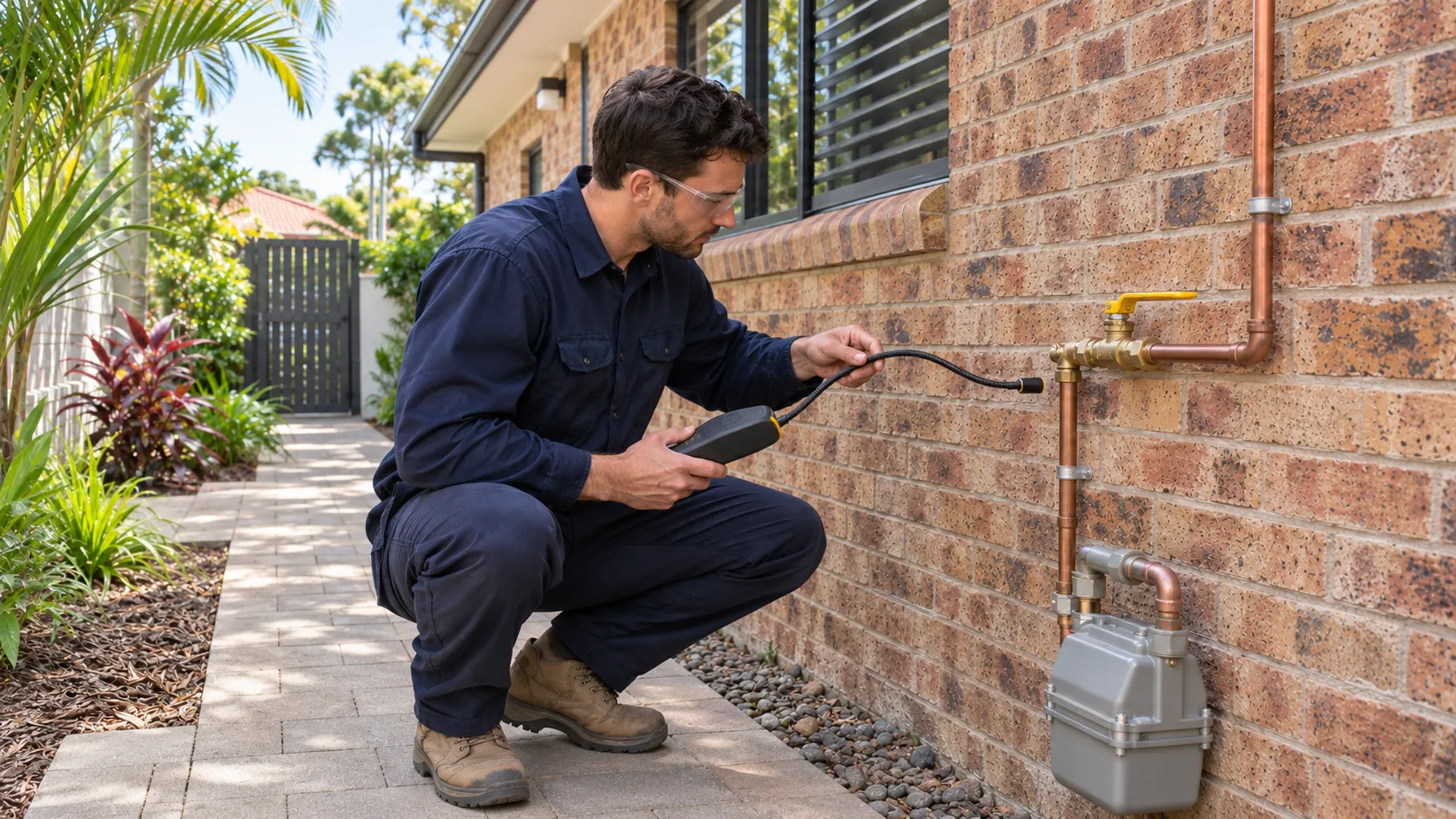
A gas fitter will consider the reported circumstances and assess the relevant parts of the installation within their scope. Depending on the concern, this may involve:
- Inspecting accessible gas pipework, joints and appliance connections.
- Carrying out appropriate tests to identify leaks.
- Assessing potentially affected gas appliances and their components.
- Identifying damaged, deteriorated or incorrectly installed fittings.
- Determining whether additional specialist or distributor involvement is required.
The testing methods depend on the installation and the suspected fault. Homeowners should not attempt to reproduce the leak or demonstrate the problem by operating equipment.
A professional investigation may also show that further assessment is necessary before the source can be confirmed. An initial visit does not automatically mean every appliance or section of pipework has been cleared for use.
Ask which parts of the installation have been checked, whether the suspected fault has been identified and what equipment must remain disconnected. If the problem involves equipment or infrastructure outside the attending professional's scope, request clear information about who needs to attend next.
Repairs and Confirmation Before Returning to Use
Once a fault is identified, the required repair should be explained before work proceeds where circumstances allow. Ask which component or section is affected, what the proposed work addresses and if additional testing will be required afterwards.
Appropriate testing should confirm that the repaired section and affected equipment are safe before being returned to service. Normal appliance operation alone should not be treated as proof that the original concern has been resolved.
Before the professional leaves, request clear instructions about which appliances can be used, whether anything must remain disconnected and whether another visit or authorisation is outstanding. Relevant written findings, test results or job records can also document the work completed.
Do not reconnect, relight or restart equipment while a restriction remains in place. This is necessary where several appliances share the same gas supply. Follow the advice provided for the installation rather than assuming unaffected equipment can automatically be used.
If a gas smell returns after use has been authorised, treat it as a new safety concern. Leave the affected area, avoid ignition sources and seek assistance from a safe location. Report the previous assessment and repair, but do not assume the returning smell has the same cause.
What Should Brisbane Homeowners Remember?
A gas smell inside a home should never be dismissed simply because the stove, heater and hot water system are switched off. Supply pipework and connections can still carry gas while appliances are idle, and the source of an odour cannot be reliably identified without assessment.
The safest response is to move away from the affected area, avoid potential ignition sources and contact emergency assistance when required. Any suspected fault should be assessed by a licensed gas fitter, with further distributor or specialist involvement. Appliances should only return to use after an expert has confirmed that the installation is safe.
Plumbing Inspectors can assist with plumbing enquiries and clarify whether gas fitting services are appropriate for the reported issue. Taking an unexplained gas smell seriously and arranging the correct assessment can protect household occupants and prevent an unresolved fault from becoming a more serious emergency.