

Why Outdoor Drainage Fails in Heavy Rain
Heavy rain has a way of exposing every weakness in an outdoor drainage system. What seems to cope during light showers can suddenly back up, flood or fail outright once a real storm hits. Plumbing Inspectors sees the same underlying issues repeated on properties of every size, which means many of these problems are predictable and preventable. This article explores why outdoor drainage systems struggle under intense rainfall, including poor design and grading, inadequate capacity, blocked or poorly maintained components and hidden defects in below-ground pipework.
Readers will learn how surface water behaves during heavy downpours, why systems that look adequate on dry days can be critically undersized and how small installation errors lead to major failures when it matters most. Plumbers will also highlight the warning signs that blocked drains in Brisbane are close to failing, along with the practical steps owners, builders and facility managers can take to reduce risk. Understanding these issues is essential to protecting buildings, landscaping and infrastructure from water damage and ensuring that drainage systems perform reliably when the weather is at its worst.
Why Heavy Rain Overwhelms Outdoor Drainage
Heavy rain can expose weaknesses that seem invisible in normal weather. A yard or stormwater system that copes fine with light showers may fail within minutes once rain intensity exceeds what the drains, pipes and ground can physically handle. Plumbers often find that failures in heavy rain are not due to a single fault but to several small limitations adding up at the same time.
Understanding why heavy rain overwhelms outdoor drainage helps property owners focus on the right fixes rather than just reacting to surface flooding. It usually comes down to capacity, flow path and what the water is carrying with it.
Drainage Systems Have Limited Capacity
Every part of an outdoor drainage setup has a design limit. Grates, gutters, downpipes, stormwater pits and underground pipes are sized to handle a certain volume of water per minute. When rainfall intensity exceeds this capacity, water will start to back up.
Heavy bursts of rain often deliver more water than the original designer allowed for. Common issues include:
- Roof catchment areas feeding into undersized downpipes or a single small stormwater line
- Yard drains and strip drains that are too few in number or spaced too far apart
- A long flat pipe runs with minimal fall that cannot move water away fast enough
Once the inlets are full, water spreads sideways across paths, driveways and lawns. If there is no secondary overflow route away from the building, it will seek the lowest point, which is often a garage slab, subfloor vent or door threshold.
Ground Saturation Limits Infiltration
In moderate rain, the soil itself acts as part of the drainage system by absorbing water. During prolonged or intense storms, the ground can reach saturation. At that point, almost all additional rainfall becomes surface runoff.
Clay soils are especially prone to this problem because they absorb water slowly and hold it tightly. Compacted fill, driveways and paved areas make it worse because they are almost impermeable. Water that cannot soak into the ground must find the nearest surface route to a drain or boundary.
Plumbing experts frequently see yards where landscaping has raised garden beds or lawns above slab height. In heavy rain, these saturated areas shed water back towards the building foundation. Even if stormwater pipes are clear, the volume hitting the house perimeter can exceed what perimeter drains can carry.
Debris, Sediment and Air Locks Restrict Flow
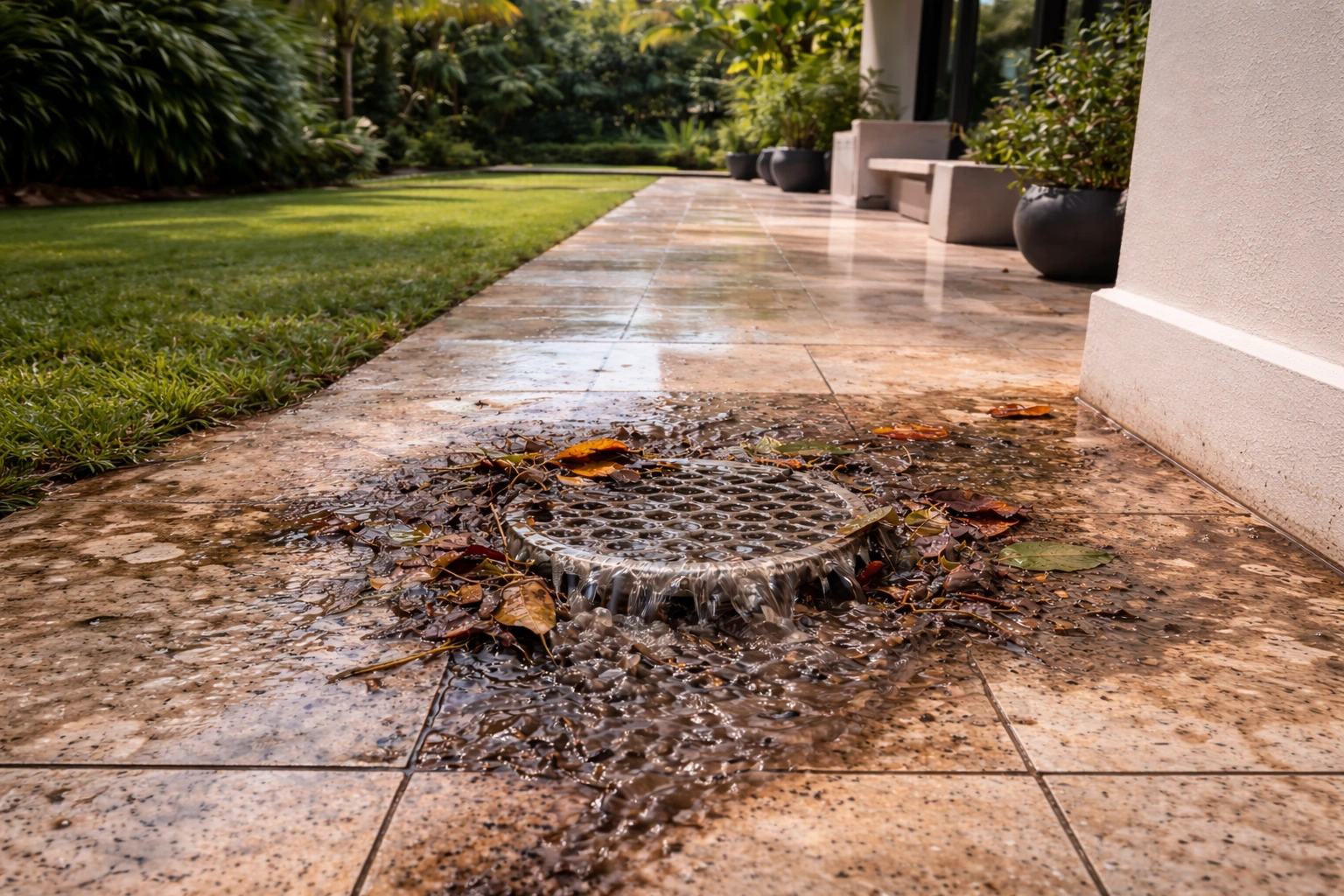
During heavy rain, water picks up leaves, mulch, soil and litter. This material moves quickly into gutters, pits and pipes. If maintenance has been irregular, partial obstructions turn into complete blockages exactly when maximum capacity is needed.
Blocked or restricted points often include:
- Grates covered by leaves, bark or gravel
- Downpipe elbows filled with leaf litter or birds’ nests
- Silted-up stormwater pits where sediment has reduced the effective depth
In underground pipes, trapped air pockets can also reduce flow. When high volumes enter suddenly without adequate venting, air compresses in front of the water and slows it down. Combined with debris, this can make a marginal system fail under storm conditions.
Blockages That Stop Stormwater From Draining
Blockages are one of the most common reasons outdoor drainage systems fail during heavy rain. Even a partial obstruction in a grate, pipe or pit can drastically reduce flow, causing water to back up, pool around buildings and overwhelm downstream infrastructure.
Inspectors regularly see that what starts as a small build‑up of leaves, silt or rubbish becomes a solid plug once a storm hits. Understanding the typical sources of blockage and how they behave in heavy rain helps property owners prevent avoidable flooding and structural damage.
Surface Debris at Grates and Inlets
The first choke point is usually at the surface level. Yard grates and strip drains along driveways and kerb inlets collect leaves, bark, mulch, lawn clippings, litter and even loose gravel. In light rain, this material may sit harmlessly on top. In a downpour, fast‑moving water drags everything to the lowest point and packs it tightly over the grate openings.
The result is a sheet of water running across the surface instead of entering the system. This is common on driveways sloping towards garages and on patios that rely on a single strip drain. Water will always follow the easiest path, so if the grate is covered, it will head towards door thresholds, slab edges or neighbouring properties.
Regular sweeping and clearing around grates before forecast heavy rain is one of the simplest risk controls. Plumbers also advise checking that grates are correctly sized and not obstructed by landscaping, paving lips or overgrown garden beds that trap debris against the inlet.
Silt, Sediment and Tree Roots in Pipes
Below ground, the main causes of reduced capacity are silt build‑up and root intrusion. Fine sediment enters through open joints, cracked pipes, unsealed pits and unprotected garden beds that wash into drains. Over time, this settles in low spots and bends, forming a shallow layer that narrows the pipe. During heavy rain, this restriction can be enough to cause water to back up out of pits and grates.
Tree roots are attracted to the moisture and nutrients in stormwater lines, especially where joints are old or damaged. Small roots penetrate tiny gaps, then thicken and branch out inside the pipe. This creates a fibrous mass that catches leaves and silt until the line is almost completely blocked. In heavy rain, the flow cannot get past the obstruction, so pits fill quickly and surface flooding occurs.
Drainage specialists recommend periodic CCTV inspections of older or heavily vegetated properties and mechanical cleaning, such as jetting to remove silt and root masses. Where root intrusion is recurring, targeted repair or pipe relining is often required to permanently seal joints.
Poorly Managed Runoff From Roofs and Yards
Blockages are also created when roof and yard runoff are not properly controlled. Broken or missing gutter guards allow large leaf loads into downpipes and stormwater lines. In a cloudburst, this material can lodge at the first bend or junction and act like a plug. Similarly, unprotected soil or mulch mounds besides surface drains wash straight into grates and pits during storms.
Inspectors often find that simple layout issues contribute to blockage risk. For example, multiple downpipes discharging into a single undersized line or garden overflows directed into a pit that was never designed for that volume. These conditions accelerate debris build‑up and reduce self‑cleaning velocities in the pipework.
Good practice includes keeping gutters clean, fitting appropriate leaf guards, stabilising garden beds near inlets and ensuring runoff is distributed across adequate drainage points so that no single pipe is overloaded or prone to collecting all debris.
Ground Slope and Surface Water Flow Problems
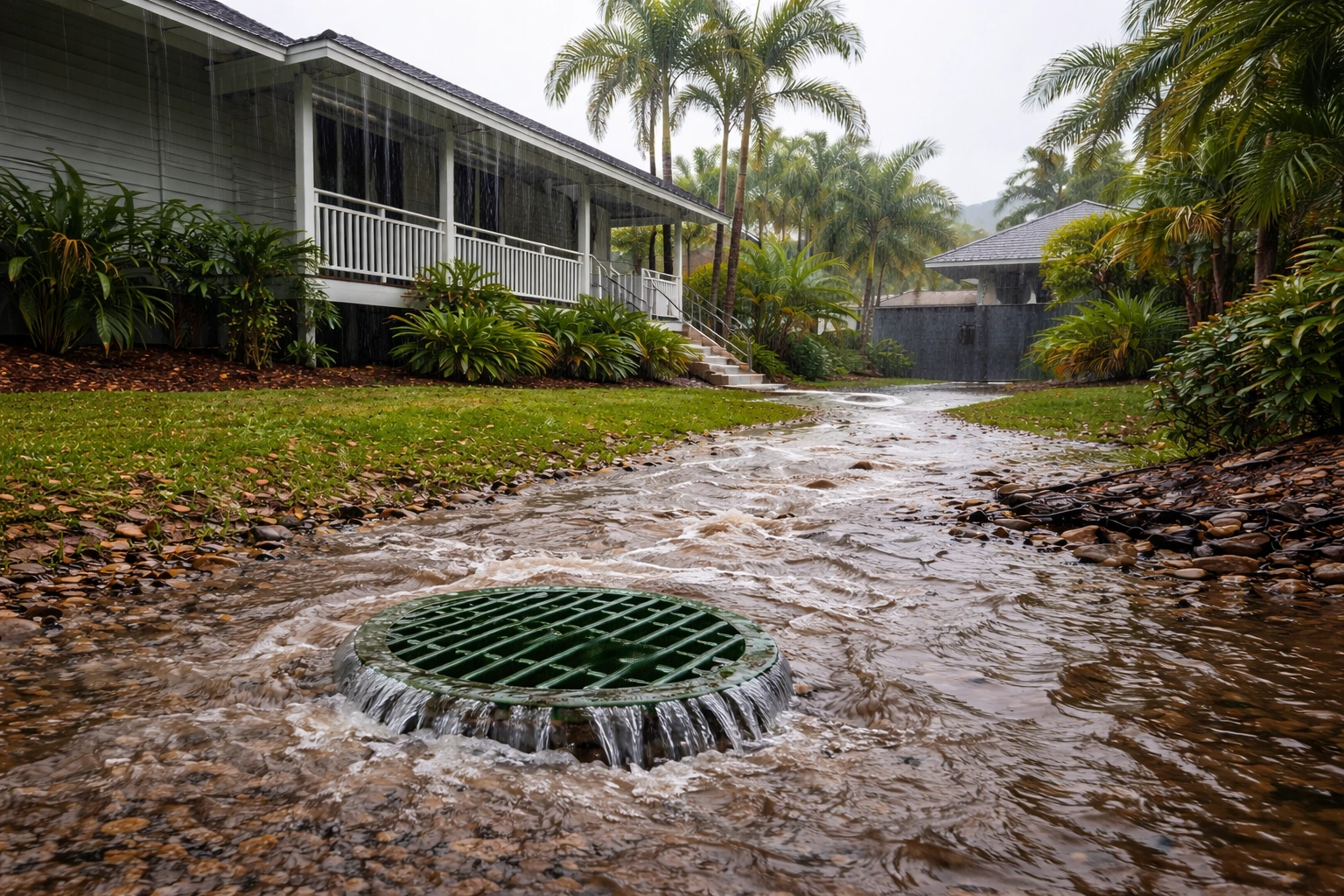
Poor ground slope is one of the most common reasons outdoor drainage fails in heavy rain. When the land around a building does not direct water away efficiently, it collects near foundations, paths and low-lying garden areas, then overwhelms drains and soakaways. Drainage inspectors often find that correcting the slope and surface water pathways solves repeated flooding that no number of extra drains can fix.
This section explains how ground slope should work, what goes wrong in real gardens and driveways and what practical measures owners and contractors can take to restore proper surface water flow.
Why Ground Slope Matters Around Buildings
For most properties, the basic rule is simple: the finished ground level should fall away from the building on all sides. As a guide, drainage professionals usually look for at least a gentle fall in the first 2 to 3 metres away from walls so that surface water naturally moves towards lawns, gullies or purpose-built channels instead of back to the structure.
If the surface is flat or sloping towards the building, even a moderate downpour can drive water against walls, into slab joints and over thresholds. This leads to:
- Standing water against foundations
- Saturated garden beds that drain into the house
- Water entering air bricks, garages or under suspended floors
These problems are made worse when hard surfaces, such as concrete or paving, have replaced soil without proper falls or edge drainage.
Common Slope Problems That Cause Flooding
Eventually, landscaping changes can completely alter the way water travels across a site. Experts frequently see issues created by:
Ground-level build-up. Repeated layers of topsoil mulch or new turf gradually lift garden beds and lawns above the original damp-proof level. Water then runs from higher garden areas towards the house instead of away.
Incorrectly laid paving or driveways. Block paving, concrete or asphalt needs a controlled fall towards a gully drain channel or permeable area. If the contractor sets levels by eye or matches neighbouring surfaces without checking falls, water may collect in the middle of the drive or run straight to the garage door.
Sunken or compacted areas. Vehicle loads, tree roots and natural settlement can create local depressions. These act as unintended ponds that fill quickly during heavy rain, then overflow into adjacent structures, drains or neighbouring properties.
Boundary changes. New fences, walls or raised beds can block existing surface flow paths. Water that once travelled harmlessly to a rear garden or open swale may now be trapped against a wall or redirected into a patio or stairwell.
Practical Ways To Improve Surface Water Flow
Plumbing Inspectors advises that any drainage solution starts with correcting surface levels where possible. Even small adjustments can greatly reduce ponding and pressure on drains.
On hard surfaces, this often means re-laying sections of paving to establish a consistent fall and adding linear channel drains at doorways or along the bottom of slopes. These channels should discharge to a suitable surface water system or sustainable drainage feature, not to foul sewers.
In gardens, simple regrading can create shallow swales and low points that guide water away from the building. Spoil from regrading should not be piled against walls or over air bricks, as this traps moisture and may bridge damp-proof courses. Where regrading alone is not enough, a combination of surface reshaping, permeable surfacing and appropriately positioned gullies usually provides a reliable long-term solution during heavy rain.
Signs Outdoor Drainage Is Failing
When heavy rain hits, there are clear warning signs that outdoor drainage is not coping. Spotting these indicators early allows homeowners to call drainage experts before minor surface water problems turn into structural damage or flooding inside the home.
Some symptoms appear during a storm, while others are only obvious afterwards. They recommend checking the property while it is raining; if it is safe to do so, then walking the site again a few hours after the rain has stopped to see how quickly the water clears.
Standing Water That Lingers
The simplest sign of poor drainage is water that sits on the surface long after rain has stopped. Puddles that remain for more than 24 to 48 hours in garden beds, on lawns or on hard surfaces usually point to either compacted soil, poor grading or blocked drainage.
On turf, this often looks like shallow ponds that squelch underfoot. In garden beds, the topsoil may appear saturated and muddy with mulch floating away. On driveways, patios or paths, ponding in low spots indicates that water is not finding a way to a drain or soakaway. Drainage specialists also look for a clear “tide line” of dirt or leaf debris that shows where water has repeatedly sat during storms.
Overflowing Gutters, Drains and Downpipes
During heavy rain, the roof drainage system should carry water cleanly from gutters, downpipes and surface drains to a lawful point of discharge. When that system is failing, water will escape at the weakest point.
Homeowners may notice gutters spilling over the front edge or back flooding against fascia boards. Downpipes that connect to underground drainage may gurgle loudly or back up with water visible at the base. Surface grates in patios or driveways that rapidly fill and then overflow into nearby areas are another red flag.
Inspectors also look for secondary signs like striping or staining on walls below gutters, erosion below downpipes and displaced gravel around surface drains. These show that overflow is not a one-off event but has occurred over multiple storms.
Water Against the House and Structural Clues
Water should always be directed away from the building. When drainage fails, it often collects against the house, which increases the risk of damp foundations or internal water ingress.
Typical signs include:
- Water pooling along the base of external walls
- Saturated soil right next to the slab or footings
- Moist or musty smells in subfloor spaces
In more advanced cases, plumbers may see bubbling or flaking paint near the bottom of walls, hairline cracks that reflect seasonal movement between wet and dry cycles, and efflorescence, a white powdery deposit on masonry caused by moisture drawing salts to the surface.
Erosion and Landscaping Damage
Failing outdoor drainage often reshapes the landscape. Channels cut into garden beds or lawns show where water is repeatedly scouring the surface. Mulch washed away from beds, exposed tree roots and bare patches of soil are all signs that runoff is too intense for the current drainage design.
On sloping sites, erosion may appear as small landslips, collapsing garden edges or undermined paths and retaining walls. Plumbing Inspectors treat this as a serious indicator that surface water is being mismanaged during heavy rain and that drainage capacity or layout needs to be reviewed.
Ageing or Undersized Stormwater Systems
Many drainage failures in heavy rain can be traced back to stormwater systems that are simply too old or too small for current conditions. Eventually, pipes corrode or collapse, and rainfall intensity often exceeds the design assumptions used when the system was first installed. The result is surface flooding, water backing up through grates and increased risk of damage to buildings and landscaping.
Experts frequently find that properties have never had their stormwater capacity checked against modern rainfall data or changed site conditions. Extra roof area, new hardstand surfaces and extensions are often added without upgrading the underlying drains. When a major downpour hits, the system cannot cope, and water has nowhere to go except overland.
How Age Affects Stormwater Performance
Older stormwater networks were typically built from vitrified clay or thin‑wall PVC. Clay joints can open up or become displaced, which allows tree roots to enter and block the line. PVC can sag or deform if it was not bedded correctly. Over the decades, this leads to reduced internal diameter and poor flow even if the pipes are technically still “intact”.
Ageing systems also suffer from:
- Corrosion or spalling in concrete pits and pipes creates rough surfaces and snags debris
- Collapsed sections where soil movement or traffic loading has crushed the pipe
- Slumped grades that create low points where water and sediment sit rather than draining
Externally, the system may look fine with intact grates and downpipe connections. The real problems are underground, which is why CCTV inspection is essential on older properties.
Undersized Pipes and Inlets in Modern Storms
Many existing systems were designed for smaller catchments or for less intense storms than are now common. A line that was acceptable when the house had a simple gable roof may be inadequate once extra storeys, patios and garages have been added.
Common undersizing issues are:
- Pipes smaller than 90 mm serving long runs of roof or driveway
- Multiple downpipes are combined into one line without upsizing the pipe
- Too few yard or strip drains in large paved or landscaped areas
In heavy rain, this shows up as water surging out of downpipe connections or bubbling from surface grates. The pipes are flowing full, so extra water is forced to bypass the system and flow across the ground.
Identifying When Replacement or Upsizing Is Needed
Not every ageing system requires full replacement, but some clear warning signs indicate that repairs alone are unlikely to solve flooding. These include repeated surcharges at the same locations during storms, extensive root intrusion along multiple joints and historic pipe materials that are no longer fit for purpose under modern loading.
First, confirm the actual pipe condition with CCTV, then calculate the required capacity based on the current roof and surface areas. If the existing lines are both deteriorated and undersized, upgrading to larger diameter PVC with improved pit design usually offers the most reliable long‑term outcome.
Everything we have covered comes back to a simple reality: outdoor drainage rarely “fails suddenly” in heavy rain; it usually fails slowly, and the storm is just the moment it finally shows. Readers learnt the full chain of causes: poorly designed grading and surface falls; undersized or incorrectly installed pipes, pits and grates; blockages from silt, roots and debris; and the critical details like pipe alignment, joint integrity, backfall and inadequate discharge points. It was also discussed how newer development patterns, increased hardstand and changing rainfall patterns are overloading legacy systems that were never engineered for today’s conditions and how shortcuts during construction or undocumented alterations compound those stresses. When you view each inspection through the proper lens, you are not only identifying defects; you are protecting structures, preventing disputes and helping ensure that the systems signed off today will stand up to the storms of tomorrow.

.webp)